
About the Hikaroroa Mt. Watkin Conservation Project
About the Conservation Group
The Hikaroroa / Mt Watkin Conservation Group is a living example of what people can achieve when they work together around a shared landscape.
The group brings together the farmers and landowners surrounding Hikaroroa with mana whenua, conservationists, volunteers, researchers, schools, community organisations and local and central government agencies. Together, we are working across property and organisational boundaries to protect the ecological and cultural values of Hikaroroa and the surrounding landscape.
Our work includes pest animal control, biodiversity monitoring, ecological research, restoration, education and community events. Alongside the ecological outcomes, the project creates opportunities for people to learn practical conservation skills, undertake training and internships, contribute to research and build careers in conservation.
At the heart of the project is a simple idea: caring for Hikaroroa works best when the people connected to this place are part of that work. By combining local knowledge, mātauraka, science, professional conservation and community effort, we hope to build a model of conservation that can endure for generations.
About Hikaroroa
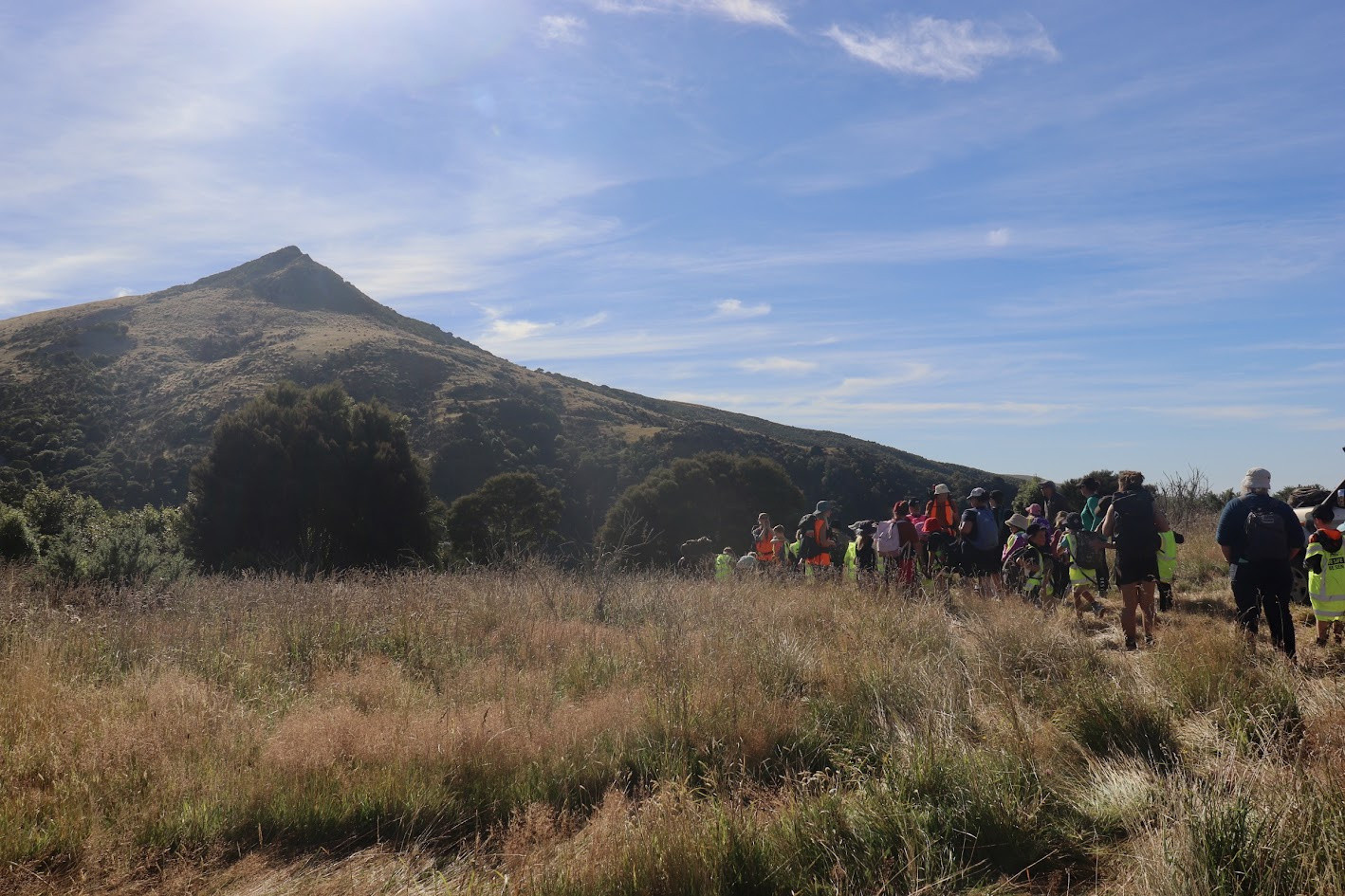
Hikaroroa is much more than a physical landmark. Rising prominently from the hills inland of Waikouaiti / Karitane, the mountain brings together an extraordinary concentration of cultural, ecological, geological and community values.
For Kāi Tahu, Hikaroroa is a mauka tīpuna — an ancestral mountain. Its name recalls a tūpuna associated with the Arai Te Uru waka, which was wrecked at Matakaea / Shag Point. Hikaroroa forms part of the wider Arai Te Uru tradition through which the landscape of coastal Otago is understood and remembered, connecting the mountain to generations of whakapapa, history and human relationships with the land.
Hikaroroa and its surrounding ecosystems were also part of a landscape of mahika kai — places where food and other resources were gathered. Protecting the mountain therefore means more than protecting individual species. It includes maintaining the health of the landscape, its cultural values and the relationship between people and place. Protection of these values remains of major significance to Kāti Huirapa Rūnaka ki Puketeraki.
The mountain's European name, Mount Watkin, commemorates missionary James Watkin, who helped introduce Christianity and literacy to the region during the 1840s. Today, the formally recognised dual name Hikaroroa / Mount Watkin reflects different layers of the mountain's history.
An Island of Native Forest
Surrounded today by a predominantly pastoral landscape, Hikaroroa's forests survive as a large island of indigenous habitat and contain some of the most significant remaining native forest in Coastal and North Otago.
The mountain supports a diverse mosaic of tōtara-mataī podocarp forest, kōwhai–lacebark–ribbonwood forest, kānuka-kapuka forest, shrublands, rocky tors and extensive basalt boulderfields recognized as nationally important geological features.
These forests provide habitat for native birds, lizards, invertebrates and plants, including species that have become uncommon across the surrounding landscape and several that are reconized as nationally threatened/critical. The ecological importance of Hikaroroa has been recognised for decades, with formal assessments identifying its vegetation and habitats as being of national significance.
Together, this mixture of geology, topography and vegetation has created an unusually diverse collection of habitats within a relatively small area and one of the only areas in our region with indiginous vegetative coverage from the valley floor to the mountain sumit.
Creation of the Reserve
The Hikaroroa / Mt Watkin Scenic Reserve exists today because people recognised that this forest was worth protecting.
During the 1970s and 1980s, ecological surveys began drawing attention to Hikaroroa as one of the few remaining examples of the original forests of the Waikouaiti Ecological District. By the 1990s, community groups were approaching the Dunedin City Council seeking stronger protection for the mountain's ecological values.
The first Mt Watkin Working Party was formed in 1999, beginning a collaborative process to determine how the most important areas of forest could be protected while recognising the surrounding working landscape.
Further ecological assessment commissioned by the Dunedin City Council in 2003 confirmed that the forests and habitats of Hikaroroa were of national ecological significance. Following negotiations with the leaseholder and further work by Council and the community, the Dunedin City Council purchased the leaseholder's interest in the property in 2004.
In June 2005, approximately 660 hectares were formally vested as the Hikaroroa / Mt Watkin Scenic Reserve under the Reserves Act 1977, securing the core of this significant area with legal protection.
Protecting Hikaroroa
Today's conservation project builds on that history.
The reserve protects the ecological heart of Hikaroroa, but ecosystems do not stop at a fence or property boundary. Native forest remnants, waterways, wildlife habitat and pest animals extend between the reserve and the surrounding farms.
The modern Hikaroroa / Mt Watkin Conservation Group therefore works across the wider Hikaroroa landscape, connecting conservation management within the DCC reserve with work undertaken by neighbouring landowners on private land.
The conservation group is only the latest chapter in a conservation story that has been developing for decades: people connected to Hikaroroa working together to protect a place they believe is worth passing on.
- See our project area and map.
- See our Mission/Values and our Biodiversity Goals.
- Meet Our Team.